
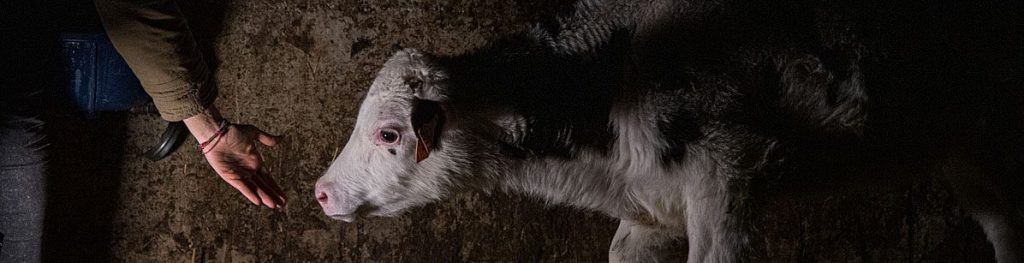
Credit: Stefano Belacchi / Essere Animali / We Animals
‘Think occasionally of the suffering of which you spare yourself the sight’
Albert Schweitzer
Every single day in Canada:
Piglets on factory farms have their teeth clipped and tails cut off
Mother pigs are confined to cages the size of a fridge, which are so small they can’t even turn around or scratch an itch
Most dairy cows are forced to live in stalls where they are tethered by the neck 24/7 for most of their lives.
Factory farmed chickens often have a space smaller than a piece of paper to live in barns crammed with up to 10,000 chickens and spend most of their lives sitting or lying in their own waste. World Animal Protection
Farming practices in Canada have changed dramatically over the last 50 to 60 years.
The number of small family farms has significantly declined, and larger intensive factory farms have become the norm for food production in the 21st century. Facilities that increased mechanization and confinement were introduced to reduce labour costs and address some animal health issues. Unfortunately, these housing systems resulted in new animal welfare issues, including the restriction of the natural behaviours of animals due to confinement and overcrowding.
Every year, more than 800 million animals are slaughtered for food in Canada, most of them chickens. The majority of Canadians assume that the government ensures the humane treatment of farm animals and are shocked to discover the lack of farm monitoring across the country. Canada has no regulations stipulating how animals should be treated on farms outside of federal and provincial animal cruelty laws, and these are only used to prosecute livestock farmers in cases of egregious abuse, such as when animals are neglected to the point of starvation or farm workers are caught torturing animals.
Once animals leave the farm, the conditions are no better. Current transportation regulations generally allow animals to be transported for up to 36 hours without food, water or rest, and trucks are poorly equipped to protect the animals from extreme heat or cold and do little to otherwise protect them from the elements.
Slaughter is another area of concern. Animals may be handled roughly as they are led to slaughter, causing significant stress and fear, as well as injuries. Some animals are improperly “stunned” (i.e.: not fully rendered unconscious) before they are killed, resulting in them being killed while conscious – causing them tremendous pain and suffering.
For both the transportation and slaughter of animals, Canada’s regulations are weak, but just as serious is the lack of enforcement of the existing regulations. News reports in recent years have revealed shocking deficiencies in enforcement of animal welfare and even food safety regulations. It is clear that funding to the Canadian Food Inspection Agency for animal welfare enforcement must be substantially increased to ensure federal regulations are being enforced consistently and effectively.
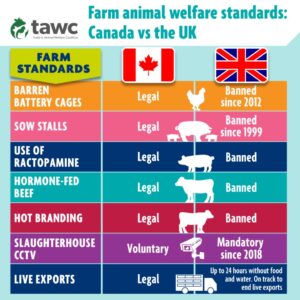
Farming, transport and slaughter practices in Canada have fallen further and further behind other jurisdictions, such as Australia, New Zealand and the European Union, where public demand for progressive policies and legislation for farm animal welfare has pushed these governments to implement progressive change for animals.
The federal government is now funding the development of new Codes of Practice for the Care and Handling of Farm Animals, which allows us to make improvements to animal welfare with direct buy-in from the farming industry. Coordinated by the National Farm Animal Care Council (NFACC), these codes can serve as reference documents for provincial animal cruelty laws when enforcement is assessing exemptions based on standards of care.
Humane Canada sits on code development committees, advocating for science-based improvements to animal welfare practices on farms across Canada.
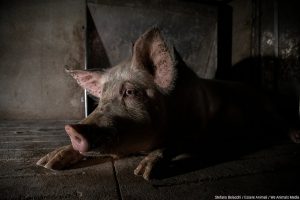
‘Cruelty thrives in secrecy, and the meat industry is highly skilled at concealing the routine abuse and misery that flourishes on modern farms.’ – Camille Labchuk, Executive Director, Animal Justice
********************
When Dr. Jane Goodall was asked what she thinks about animal factories, she responded with three words: “Pain, Fear, Death”. Animal factories are amongst the worst atrocities ever perpetrated by humanity. “Farm animals feel pleasure and sadness, excitement and resentment, depression, fear and pain. They are far more aware and intelligent than we ever imagined.”
********************
Canadian Coalition for Farm Animals post
May his innocent eyes awaken compassion
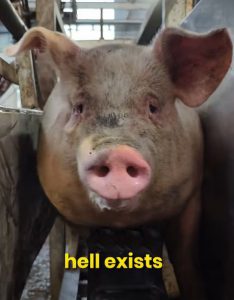
What is Factory Farming and Why is it Bad
Factory Farming: Everything You Need to Know
Factory farming was created based on the assumption that – as the name suggests – the factory concept could be applied to animal farming.This approach comes at the expense of animals, who are treated as commodities. They are unable to carry out many of their natural behaviours when crammed into tiny pens or cages and forced into a life of misery.
The Problems with Factory Farming – ASPCA
The Guardian – Animals Farmed
This series looks at how the animals that feed us live, and how the business of feeding us works. What happens to animals in the factory farming system? And what does it mean for the planet?
Canada’s Scorecard – Mercy for Animals
Animal Outlook – Investigations
No Country for Animals – documentary
Free from Harm
Farm animal advocacy and education
Do You Really Know what is going on behind the Closed Doors of Factory Farms
Motherhood: The Life Of A Mother Inside Factory Farms
A mother’s love is universal – but on factory farms, a female animal who gives birth is not considered a mother. Instead, she is considered to be a breeding machine, whose only purpose is to keep giving birth in order to keep feeding humans with her milk or the flesh of her babies
Humanewashing is a collection of widespread marketing tactics designed to deceive us into believing that most meat, egg, and dairy companies care about the welfare of farmed animals far more than they actually do
3 Things The Animal Agriculture Industry Doesn’t Want You To Know
An undercover look at pig slaughter in Canada
Alarming new secretly-recorded footage from a pig slaughterhouse shows appalling conditions and blatant violations of animal protection laws at Johnston’s Packers, a provincially-licensed slaughterhouse in Chilliwack, British Columbia. Provided anonymously to Animal Justice.
Canadian Coalition for Farm Animals – Why do we care about the lives of farmed animals?
Creature Comforts See the film we had made about farm animal transportation You will see better choices for transportation at the end of the film.